
Object Record
Images
Metadata
Object |
Flag |
Year Range from |
1812 |
Year Range to |
1830 |
Description |
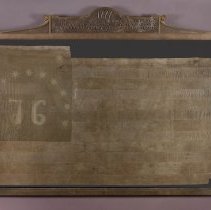
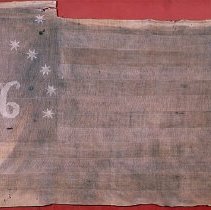
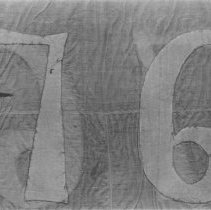
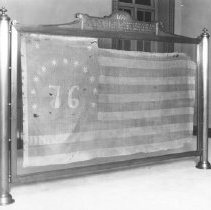
Bennington Flag or "Fillmore" flag. White "76" under rounded arch of eleven seven-pointed stars with two stars in upper corners of blue canton. Thirteen stripes alternate white and red with white on top and bottom. Upper stripe missing, pieces from upper and lower right corners missing, colors mostly faded to shades of grey. |
Width (inches) |
115.000 |
Height (inches) |
65.500 |
Subjects |
United States--History--War of 1812. |
Information |
One of the oldest and most famous American flags in existence, the Bennington Flag is unique in its use of white stripes for outer bars, and the arrangement of seven-pointed stars with the number "76" in the canton. It is believed that Nathaniel Fillmore commissioned the creation of this flag in the early nineteenth century. Previous scholarship had suggested that the flag was carried in 1777 in the Battle of Bennington. A technical assessment of the fibers conducted as part of a 1996 conservation process, revealed that the flag is composed entirely of cotton. Cotton fabric was not readily available in American until after 1800, making it improbable that the flag flew at the Battle of Bennington. The single and double ply yarns of the fabric and sewing thread are characteristic of this early phase of cotton milling technology. Nathaniel Fillmore, a veteran of the Revolutionary War and a participant of the Battle of Bennington, probably presented this flag to his nephew, Septa Fillmore, shortly after the outbreak of war between the United States and England in 1812. The "76" in the flag design may commemorate a Revolutionary War victory over the English. Colonel Septa Fillmore served with distinction during the War of 1812 with a command at Plattsburgh, New York; it is probable that the flag was displayed there. The Bennington flag remained in possession of the Fillmore family, passing from Septa Fillmore to his nephew Philetus P. Fillmore who displayed it outside of his home in Aurora, Illinois, during the centennial celebration of 1876. Franklin Bosworth Fillmore, a nephew of Philetus and next owner of the flag, moved it to Monticello, Minnesota. He carried the flag at the head of a parade of the National Encampment of the Grand Army held in Minnesota in 1887. A souvenir hunter vandalized the flag at this event, removing one of the stars and the top white stripe. Maude Fillmore Wilson donated the flag to the Bennington Museum in 1926. It was on continuous display until 1995 when it was removed for conservation. Extensive cleaning revealed vestiges of the original red and blue dyes. Early nineteenth century fabrics were dyed with a variety of natural substances, such as madder (red) and indigo (blue) from plants and cochineal (red) from insects. These natural dyes are very susceptible to fading and damage from exposure to light, particularly the ultraviolet rays found in sunlight and artificial light. In addition, frequent use of flags in outdoor settings causes damage from rain and pollution. The Bennington Flag has been encapsulated in a plexiglass box to protect it from dirt, dust, and rapid changes in temperature and humidity. Light levels on the flag are kept low to reduce further loss of color. |
Related People |
Fillmore, Philetus Perkins Fillmore, Septa Fillmore, Franklin Bosworth |
Credit line |
Gift of Mrs. Maude Fillmore Wilson |
Catalog Number |
A60 |