
Object Record
Images
Metadata
Object |
Painting |
Title |
View of Bennington |
Artist/Creator |
Earl, Ralph |
Date |
1798 |
Description |
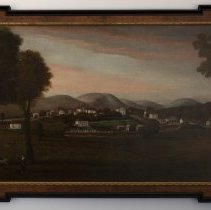
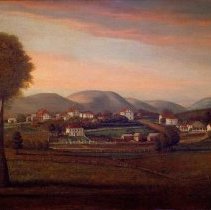
Oil on canvas painting, "View of Bennington" or "Townscape of Bennington" by Ralph Earl (1751-1801). Original carved wooden frame. Roads running across picture (present West Road and West Main Street) and up hill in center (present Monument Avenue). Two trees in foreground on left with dog and three people including an artist sketching the scene. |
Width (inches) |
40.000 |
Height (inches) |
30.000 |
Subjects |
Walloomsac Inn |
Information |
The landscape paintings of Ralph Earl are among the earliest and finest examples of the genre which, with the emergence of the Hudson River School in the late 1820s, became one of the most vital movements in 19th-century American art. During the late 18th century, landscape scenes appeared most typically in portrait background and depicted the residence or property of the sitter. Earl's landscape paintings stand out, therefore, as significant exceptions to the general practice. Earl was born in Worcester, Massachusetts, and began his painting career in New Haven, Connecticut, shortly before the outbreak of the American Revolution. Motivated by loyalist sympathies, Earl left America for London in 1778, where he studied with Benjamin West and exhibited portraits at The Royal Academy. Following his return to America in 1785, Earl travelled throughout New England and achieved recognition as one of the foremost American portraitists of that era. In 1798 his travels brought him to Bennington, Vermont, where he painted the portraits of Mary Schenck Dewey and her husband, Captain Elijah Dewey. Dewey's imposing, gambrel-roofed house is featured in the background of his portrait, and reappears in the View of Bennington also painted by Earl. Other buildings visible in the landscape that still stand include the Governor Isaac Tichenor homestead in the center foreground, the Parson Jedediah Dewey house at the far right, and the General David Robinson house half way up the hil to the present site of the Bennington Battle Monument. To the left of the Robinson house and directly above the Tichenor homestead stands the first courthouse in Bennington County, which burned dow in 1809. Earl's monumental view of Bennington represents one of his finest landscape efforts, provides historians with an invaluable record of the town, and contains the only known self-portrait of the artist, who appears busily sketching in the left foreground. |
Related People |
Earl, Ralph |
Credit line |
Museum Purchase |
Catalog Number |
1981.61 |